Colóquios

"Explosões de Buracos Negros?" por S. Hawking: Cinquenta Anos de Legado | Colóquio DFMA

Data: 
terça-feira, 2 Julho, 2024 - 16:00 até 17:00
Palestrante: 
Dr. Bruno Arderucio (UNAM)
Resumo: 


ResumoHá cinquenta anos, um trabalho seminal de Stephen Hawking foi publicado na revista Nature. Nele, foi-se anunciada a radição emitida por buracos negros que levaria o nome do autor. Desde então, o fenômeno foi intensamente estudado por inúmeros autores e influenciou diversos campos da física teórica. Neste colóquio, exploramos a relevância da descoberta e algumas das repercussões que ainda hoje são estudadas. Daremos ênfase a avanços recentes na termodinâmica de buracos negros, ao chamado "paradoxo da informação" e ao relacionado "paradoxo do tempo de Page".

Defect RG flows in 3d Chern-Simons-matter theory | Colóquio DFMA

Data: 
terça-feira, 23 Abril, 2024 - 16:00
Palestrante: 
Dra. Márcia Tenser
Resumo: 

Abstract: In this talk I would like to discuss the defect renormalization group flows recently found in ABJM theory. In such a setting, we find RG flow trajectories that may or may not preserve some subset of the original N=6 supersymmetry. The $\beta$-functions have a rich spectrum of fixed points representing (super)conformal defects that provide a rich arena to study quantum effects in 2+1 dimensional theories. This sheds new light on universal information about the theory, such as the Bremsstrahlung function, and possibly on the holographic dual setting of strings in AdS4xCP3.


Probes of ultralight dark matter and primordial black holes with gravitational-wave detectors | Colóquio DFMA

Data: 
sexta-feira, 1 Março, 2024 - 16:00 até 17:30
Palestrante: 
Dr. Andrew Miller
Resumo: 

Resumo: Gravitational-wave interferometers can be used to probe the existence of dark matter. Different types of dark matter, such as sub-solar primordial black holes, axions and dark photons, could leave different imprints on gravitational-wave detectors. While arising from physically different sources, such signals share common traits, and can be searched for with similar methods. In this talk, I will explain how persistent, quasi-monochromatic signals in ground-based detectors could arise from each of the aforementioned dark matter candidates. I also describe some of our search methods and summarize results from the most recent observing runs of Advanced LIGO, Virgo, and KAGRA. 


The observer-dependence of the Hubble parameter: a covariant perspective | Colóquio DFMA

Data: 
quarta-feira, 29 Novembro, 2023 - 16:00 até 17:00
Palestrante: 
Dra. Jessica Santiago
Resumo: 

Resumo: Given the exponential growth on the upcoming supernovae data available, the possibilities of rigorously testing the cosmological principle becomes ever more real. One of the ways to do so is by measuring the multipole decomposition of the Hubble and deceleration parameters. In this presentation, I will discuss the observational-theoretical approach, initially introduced by Kristian & Sachs, which allows for the interpretation of data in non-homogeneous and anisotropic universes. I will also explore the effects introduced by the relative motion between the observer and the reference frame defined by galaxies (the matter frame), demonstrating that the luminosity distance should be corrected in such cases.
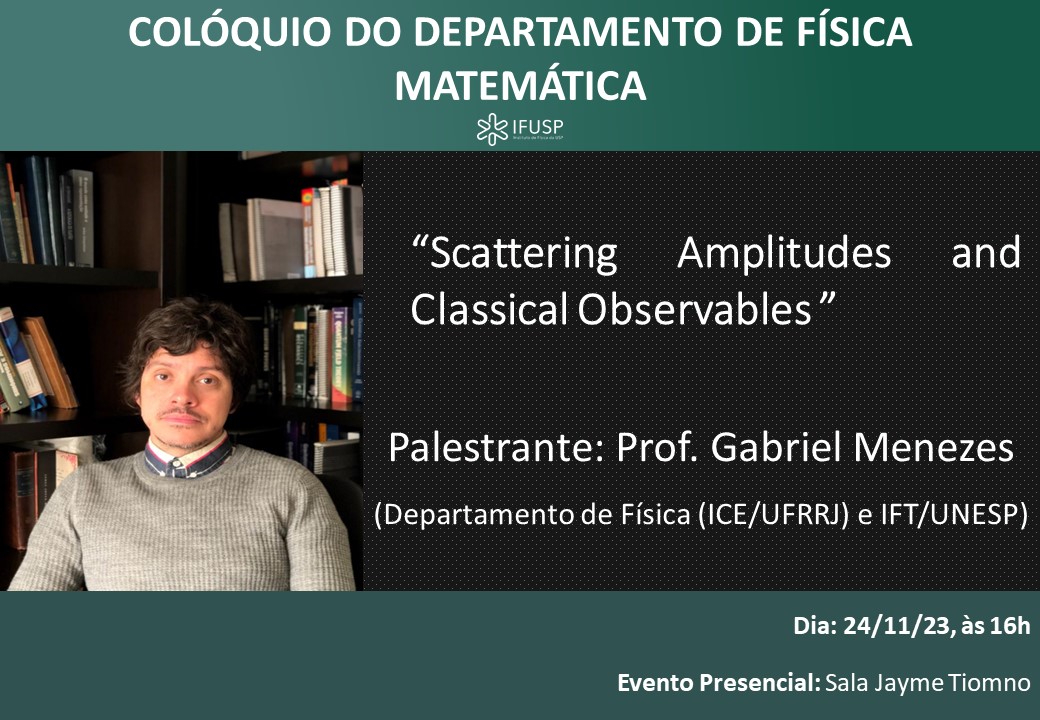
Scattering Amplitudes and Classical Observables | Colóquio DFMA

Data: 
sexta-feira, 24 Novembro, 2023 - 16:00 até 17:00
Palestrante: 
Prof. Gabriel Santos Menezes
Resumo: 

Resumo: Scattering experiments play a key role in the understanding of the fundamental aspects of nature. In this respect, scattering amplitudes have a paramount physical significance through their contribution in the calculation of scattering cross-sections, the primary observables in this context. On the other hand, amplitudes have also been applied successfully to assess features of general-relativistic problems. In this talk I will review some basic techniques which are important in the modern research on scattering amplitudes as well as discussing some current trends and future perspectives, with a particular focus on the black-hole binary dynamics and classical observables.

Páginas

Desenvolvido por IFUSP