Cosmology
One of the key problems in cosmology is the nature of its "dark" components: dark energy and dark matter.
Dark matter is a hypothetical particle which basically does not interact with "normal" matter (atoms) or light, and it accounts for about 80% of the mass in galaxies and in galaxy clusters. Although still unproven (in terms of any confirmed direct or indirect detection), it is consistent with a huge number of astronomical observations, from the rotation curves of galaxies to direct estimates of the masses in galaxy clusters. However, after more than 80 years, we still don't know what exactly is dark matter -- but physicists are looking for it in every conceivable way.
Dark energy, on the other hand, is the hypothetical componente responsible for the accelerated expansion of the Universe. In contrast to dark matter, it cannot be found in gravitationally bound structures such as planetary systems, galaxies or even galaxy clusters: if it exists, it is spread almost homogeneously across the Universe. Dark energy was first found when astronomers used Type Ia supernovas to measure distances to those exploding stars, and found that the data showed that the expansion rate has been increasing for the past few billions of years -- something which should not be happening with the "usual" components such as atoms or dark matter.
Astronomical data today indicates that, of the total budget of matter/energy in the Universe, atoms (normal matter) accounts for less than 1/20 of the total, while dark matter and dark energy account for more than 95% (see the figure below).
The physical mechanism behind the acceledated expansion is still a mystery: after all, the attraction between galaxies should cause the expansion to slow down with time. In fact we know that this is exactly what happened for the first ~8 billion years of the history of the Universe. However, at some point this trend reversed, and the expansion rate started to accelerate.
The simplest explanation for this reversal is that the Universe was dominated by "normal" matter (atoms) and dark matter, but with the expansion these components became more and more diluted. Dark energy, on the other hand, somehow does not get diluted with the expansion, and its effect is to increase the rate of that expansion. Of course, this is not a very satisfactory explanation, even if there are physical models that lead to this scenario. Dark energy remains one of the deepest and most fundamental questions of modern science.
Astrophysics
My main interest lies in the astrophysics of extragalactic objects such as galaxies, quasars, supernovas, kilonovas, etc. This is mainly because these super bright objects can be used to map the Universe and to study cosmology!
Galaxies
If you have come this far, your probably know that our galaxy, the Milky Way, is but one of an apparent infinitude of galaxies in the observable Universe. Some estimates put the number of galaxies in the observable Universe at hundreds of billions. We are now coming to a point where we can actually see more than half of that observable Universe -- up to distances of more than 20 billion light-years (redshifts greater than z~10). At the time when the light we observe here left that distant galaxy, the Universe was less than 400 million years old.
Galaxies come in every conceivable type: elliptical, spiral, irregular, with or without bars, irregulars, large, small, young, old... every one of them tells us something different about the Universe, and how it comes they ended up in their special locations.
In partickar, these galaxies can be used to map the distribution of matter (both visible and invisible!), which helps us understand how that structure was formed and how dark matter and dark energy affected this mechanism.
Galaxy clusters and groups
 A large fraction of the galaxies are found in groups or clusters: swarms of galaxies bound by their mutual gravitational attraction. Groups are made of up to ~20 galaxies, while clusters may contain up to hundreds of galaxies.
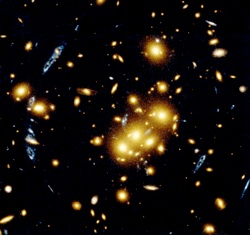
The largest galaxy clusters have masses of up to 1015 Solar masses, or the equivalent to a million times the mass of the Milky Way. However, the vast majority of that mass is in the form of dark matter. One of the most direct (or better: least indirect) ways to measure that dark matter is through the effect of gravitational lensing. In the figure (made by the Hubble Space Telescope) we see, in yellow and red, a set of galaxies that make up a galaxy cluster. In blue we can see a single galaxy which is actually behind that cluster, but that appears multiple times in the image. Yes, ONE galaxy but multiple images! What is happening is that the gravity of the galaxy cluster is so strong that it acts as a distorting lens, deforming the path of the ligh of the backgroun galaxy, generating multiple paths that lead to the telescope, and resulting in multiple images of the same obect.
From observations such as this astronomers have been able to compare the mass in atoms (stars, gas, plasma, etc.) with the total mass, which can be inferred from the gravitational lens responsible for the multiple images. Every time we compared these two masses, the result was that there is about 5-10 times more total matter than there is "normal" matter.
Quasars
 Quasars and active galactic nuclei (AGNs) are amongst the brightest objects in the Universe. It is widely believed that their luminosity comes from the infall of gas and debris onto a supermassive black hole. As this matter orbits the black hole in a death spiral, it is crunched and compressed to extremely high temperatures, shining with an incredible intensity.
My main interest lies in the astrophysics of extragalactic objects such as galaxies, quasars, supernovas, kilonovas, etc. This is mainly because these super bright objects can be used to map the Universe and to study cosmology!
Galaxies
If you have come this far, your probably know that our galaxy, the Milky Way, is but one of an apparent infinitude of galaxies in the observable Universe. Some estimates put the number of galaxies in the observable Universe at hundreds of billions. We are now coming to a point where we can actually see more than half of that observable Universe -- up to distances of more than 20 billion light-years (redshifts greater than z~10). At the time when the light we observe here left that distant galaxy, the Universe was less than 400 million years old.
Galaxies come in every conceivable type: elliptical, spiral, irregular, with or without bars, irregulars, large, small, young, old... every one of them tells us something different about the Universe, and how it comes they ended up in their special locations.
In partickar, these galaxies can be used to map the distribution of matter (both visible and invisible!), which helps us understand how that structure was formed and how dark matter and dark energy affected this mechanism.
Galaxy clusters and groups
A large fraction of the galaxies are found in groups or clusters: swarms of galaxies bound by their mutual gravitational attraction. Groups are made of up to ~20 galaxies, while clusters may contain up to hundreds of galaxies.
The largest galaxy clusters have masses of up to 1015 Solar masses, or the equivalent to a million times the mass of the Milky Way. However, the vast majority of that mass is in the form of dark matter. One of the most direct (or better: least indirect) ways to measure that dark matter is through the effect of gravitational lensing. In the figure (made by the Hubble Space Telescope) we see, in yellow and red, a set of galaxies that make up a galaxy cluster. In blue we can see a single galaxy which is actually behind that cluster, but that appears multiple times in the image. Yes, ONE galaxy but multiple images! What is happening is that the gravity of the galaxy cluster is so strong that it acts as a distorting lens, deforming the path of the ligh of the backgroun galaxy, generating multiple paths that lead to the telescope, and resulting in multiple images of the same obect.
From observations such as this astronomers have been able to compare the mass in atoms (stars, gas, plasma, etc.) with the total mass, which can be inferred from the gravitational lens responsible for the multiple images. Every time we compared these two masses, the result was that there is about 5-10 times more total matter than there is "normal" matter.
Quasars
Quasars and active galactic nuclei (AGNs) are amongst the brightest objects in the Universe. It is widely believed that their luminosity comes from the infall of gas and debris onto a supermassive black hole. As this matter orbits the black hole in a death spiral, it is crunched and compressed to extremely high temperatures, shining with an incredible intensity.